
It begins with "I want to kill them"
A record of wildlife damage can't be written prettily. In July 2016, the first year after clearing, I wrote this:
The rice is growing really well
showing splendid tillering
and yet deer have eaten about a third of it
I want to kill them
(Blog "Landing on the Soil", "Ravaged by deer", 10 July 2016)
That's the honest truth. We're serious about this, so when we're treated with disrespect, we feel accordingly. But the other party is a wild animal. There's no disrespect about it. Human reasoning is irrelevant.
From here, a year of countermeasures began. Netting, night patrols, fireworks, scarecrows, bamboo fences, electric fences, and traps. I'll write about them in order. That is also, as it happens, the order of failures.
A year of wildlife measures
Before the details, here's the year's work on wildlife measures.
[March] Install and check the electric fence
Set up the fence before fieldwork begins. Check the equipment works (current, battery condition).
[Tillering stage (from July)] Checks and grass cutting. Deer browsing becomes a real threat
After planting, once the seedlings reach about 20 cm, they get targeted. (In 2016 we lost 30% on 10 July.)
[From heading to threshing] Checks and grass cutting. Peak damage
In 2016: damage on 18 Aug; two deer and one boar on 28 Aug; Asamurasaki wiped out on 6 Sep. They're targeted even while hanging on the racks. No letting your guard down until threshed and taken home.
[After harvest to December] Take down the fence, prepare for winter
Once all the wire is removed, bring the energiser and battery home too. The poles stay. Finish by December.
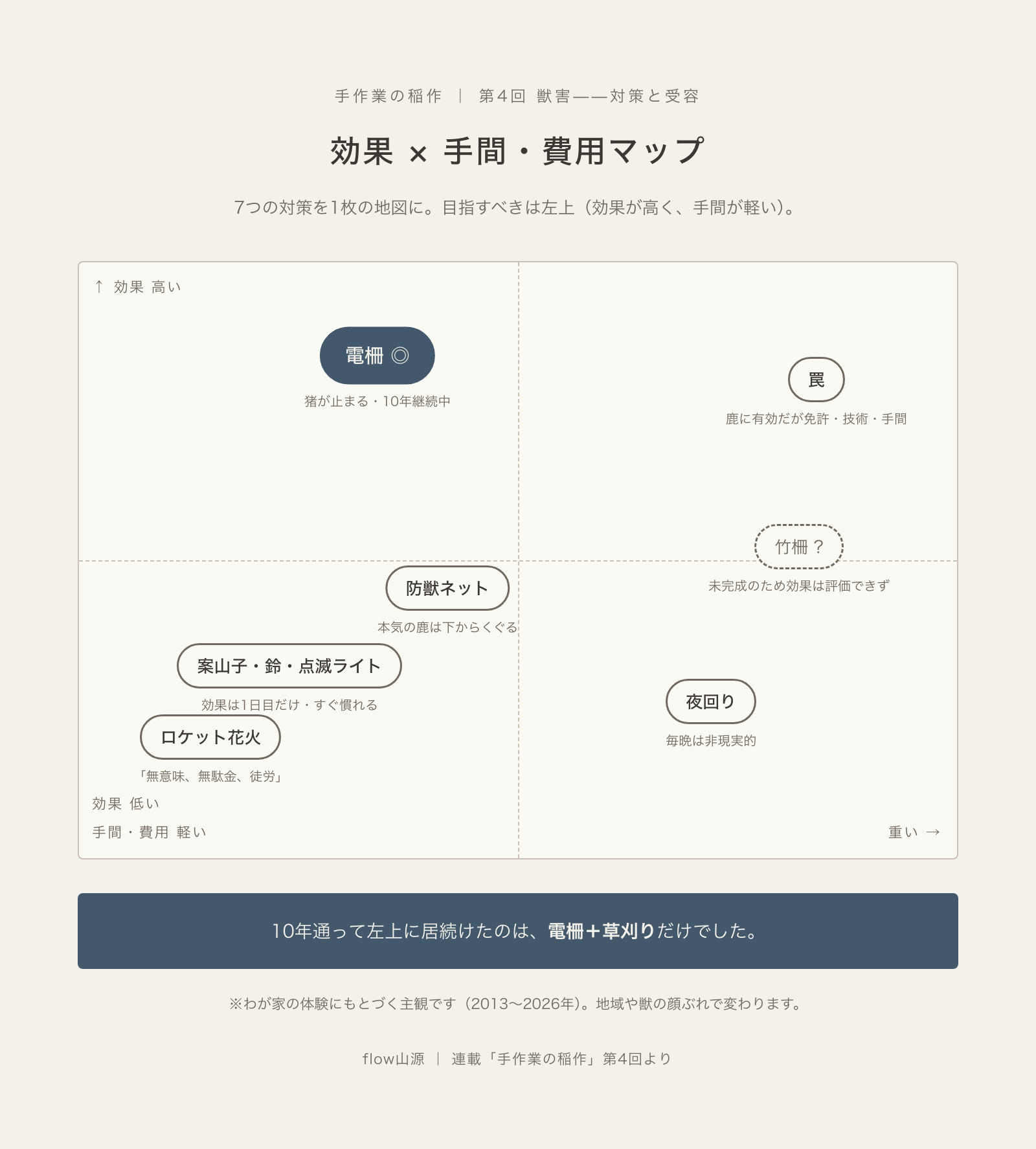
Seven measures on one page
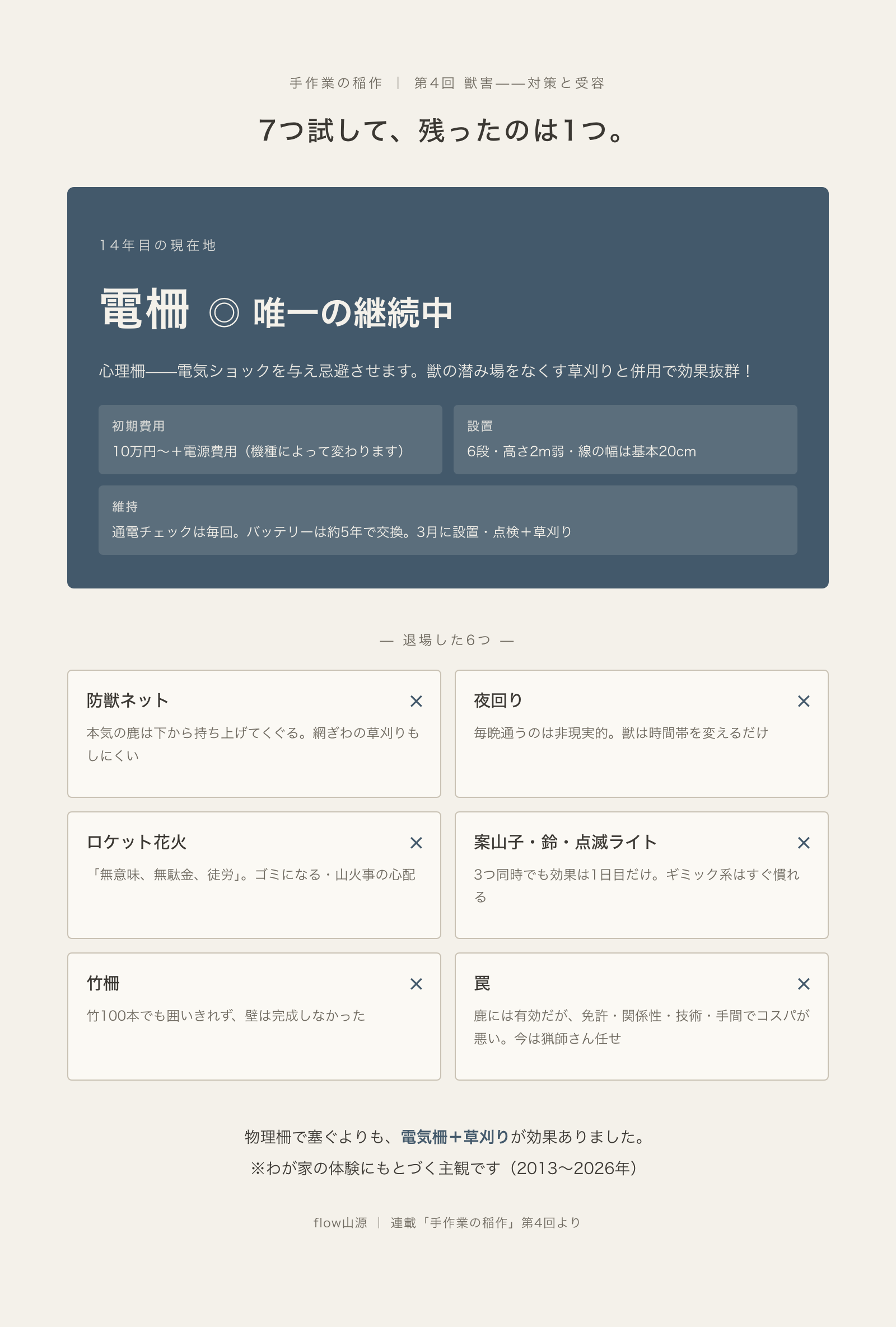
※The ratings of effect, cost, pros and cons are subjective, based on our experience (2013–2026). They vary by region and by which animals you have. (Diagram in Japanese.)
Trial and error — from netting to traps
1. Animal netting. One kind of physical fence. I used a product made from reused nori-farming nets. Very strongly made; deer have been caught in it.
It seems they pushed open a small gap in the netting between the ridge and the field and got in.
I'd doubled it so that wouldn't happen,
but one layer wasn't tied with string, so they probably slipped under easily.
Learned they lift it and crawl under far more deftly than I'd imagined.
(Blog "Landing on the Soil", "Damage by deer", 18 August 2016)
2. Night patrols. From the day of the damage, I went to the field every night after 10 p.m. For a while I stopped seeing deer and it seemed to work, but the animals were probably just changing their hours, and nightly patrols aren't realistic — I couldn't keep it up.
3. Rocket fireworks. For scaring. They become rubbish, and I worried about forest fires.
Bang with rocket fireworks several times a day, until I was sleepy —
I learned well that it was utterly meaningless, wasted money, wasted effort.
(Blog "Landing on the Soil", "Put up mesh or an electric fence", 6 September 2016)
4. Scarecrows, bells, flashing lights. I once tried all three at once. The effect lasted one day, then stopped working.
All sorts of wildlife measures have been thought up and people tell you about them, but the gimmicks all come down to "they get used to it fast; it only works at first".
5. Bamboo fence. I cut about 100 bamboo from along the stream, trimmed them to 2.3 m, and pushed them in outside the existing netting. To surround the whole field, neither time nor bamboo was enough, and the wall was never finished.
6. Electric fence. On the day the glutinous Asamurasaki was wiped out, I made up my mind.
Learned that netting can't stop deer that have come seriously intending to eat.
Need mesh or an electric fence.
(Blog "Landing on the Soil", "Asamurasaki — wiped out", 6 September 2016)
I knew before installing it: an electric fence is not an all-powerful wall.
If the voltage drops the effect weakens, and it varies with where on the deer it touches. And once they've got through, the effect of a psychological fence collapses.
The electric fence is a psychological fence.
Keep the physical fence of netting too.
Show the human world by cutting the grass.
("Landing on the Soil", "Electric fence installed", 27 September 2016)
As of 2026 I use only the electric fence. Six strands, just under 2 m high, strands basically 20 cm apart (varied by location).
Cost: at the time I think I got the whole set — energiser, wire, poles — for around 130,000 yen.
The model I recommend is the Gallagher MBS100 (the successor to the model I use and love).
I no longer use netting alongside it.
※If animals suddenly start getting in a lot, suspect a voltage drop or the battery running out at night. That's the sign to change the battery.
7. Traps. I obtained a hunting licence. I also made my own traps and actually set them.
Against deer the electric fence isn't very effective.
Removing hiding places doesn't work either.
But it stops boar, so it's worth doing.
If they don't make it a wallow, we can harvest plenty of rice.
Deer are probably best dealt with by trapping.
(Blog "All Creation", "Looking after the rain", 7 October 2017)
Traps are effective against deer, but I don't set them now. I judged the cost-benefit poor.
To set traps you need to obtain and maintain a hunting licence, which takes time and money.
After obtaining it, a relationship with the local hunters' association arises. Join, and as an organisation it brings participation in activities; don't join, and you need to work at good relations.
Traps are home-made or bought. Finding suitable spots, setting, daily checks, maintenance to keep them working — the chores pile up.
Placement isn't simply "put it on an animal trail". You mustn't enter a hunter's territory.
If something is caught, it must be dealt with properly, and ahead of other plans.
Now, in year fourteen, it's just the electric fence plus grass cutting.
About patrols
As of 2026 I don't patrol. I haven't for a good five years.
In the first year after clearing I received my baptism from the animals, and the blog where I kept the work diary holds traces of several years of trial and error.
- Patrol especially on rainy days. "They surely know that on days like this, humans don't go out." (Blog "Landing on the Soil", "Two deer, one boar", 28 August 2016)
- Check the ties along the bottom of the netting. Deer lift it from below and crawl under. (Blog "Landing on the Soil", 19 August 2016)
- Stand where they could "take a run-up and jump". The entry point was the far corner where they could run up from the road and jump. Look at the surrounding terrain, not the height of the net. (Blog "Rice Diary", 11 November 2014, the previous terrace)
- The two or three days right after damage decide the repairs. They come again once things have calmed down, when your tiredness has built up. (Blog "Landing on the Soil", "Put up mesh or an electric fence", 6 September 2016)
- Remove hiding places and make it uncomfortable. "Show the human world by cutting the grass." (Blog "Landing on the Soil", 27 September 2016)
When they make a wallow: "don't cut — stand it up"?
In September, boar turned the field into a wallow (a mud bath). Rice in a well-grown patch, not eaten, just crushed into a mess. The first time I saw it, I was at a loss.
Many times I came close to breaking: it's hopeless.
At first I cut it and hung it on the rack. An old lady who had farmed for many years said, "it's just painful — leave it, better to rest; even if you stand it up the roots are crushed, let it be", while an old man said, "you've got to stand the rice up. That's what we did in the old days." Torn between opposite advice, I tried it myself, and this is my conclusion.
If they make a wallow, straight away — even if it's cat and mouse —
I now think it's better to stand the rice up.
(Blog "Landing on the Soil", "Standing the rice up", 25 September 2016)
If I'd stood it up the day after it was flattened, I think the damage would have been much less.
(Blog "Landing on the Soil", "Standing the rice up", 25 September 2016)
And what became of the rice I cut?
The rice crushed in the wallow that I'd been drying as a test —
sure enough, hollow and no good at all.
A lesson learned.
From next time, don't cut: stand it up.
(Blog "Landing on the Soil", "Harvest, day 2", 11 October 2016)
Why was it hollow? Because it was before ripening. Boar don't care whether the rice is ripe or not; they roll about to shed their fleas and ticks.
If flattened rice ends up under water and is left, it will sprout. Then it can't be eaten. In that case, stand it up and keep it out of the water.
In my case, I tie the stood-up plants together with hemp string at the base of the ears. Four plants bundled together will stand on their own.
If they rolled about in the field like that today, I'd first check the electric fence, close the channel so water doesn't come in, and stand up the flattened rice.
End-of-chapter column: the fields I made were the animals' former home
A few days after 90% of the glutinous rice was ravaged, as I gradually came to accept it, I wrote this:
Until then it was abandoned land, the ridges gone, reeds and bamboo grass flourishing,
a place that had returned to nature,
where deer came to eat water dropwort,
and boar came to wallow —
and I turned a place like that into fields,
so of course the animals come.
For them it was the same feeding ground as every year.
It was only natural.
(Blog "Landing on the Soil", "August grass cutting begins", 23 August 2016)
By the end of that year, I had begun to doubt the very word "countermeasure".
Were "wildlife countermeasures"
a way of seeing in which people control nature?
Think instead of measures that don't make it damage.
That means re-examining the relationship between people, animals and nature.
(Blog "Landing on the Soil", "Managing the forest", 11 December 2016)
When you've just started a rice field, and until you can get a stable yield, I think it's better not to try to do everything at once.
I don't set traps now. The area around the field I leave to the hunters. In fact, trouble from wildlife has decreased. When swine fever spreads, boar decrease; deer numbers also seem to be dipping slightly. It changes every year like this, so now I've come to think, "a little is fine — just don't eat all of it."
Being murderous all the time is bad for body and mind, and no fun. If you have a family, it troubles them too. Because nobody wants to be around someone who's irritable and forever sighing.
Not demanding zero damage; as long as I receive the yield I've decided on, I want to be of a mind to accept the rest.
Next time: "Seed rice — passing life on". The story of gathering seed from the Asamurasaki the deer had wiped out.
The table of contents for the Kindle edition is here ↓
Contents map on note (in Japanese)
📚 See also
🌱 Digital DIY course materials (in Japanese)
・[Free] Site Controller Build Guide
→ https://brain-market.com/u/kinako666/a/b4cDO1UjMgoTZsNWa0JXY
・AI posts for you every day | DIY automated SNS posting in 7 days for 0 yen a month
→ https://brain-market.com/u/kinako666/a/b1MTN3UjMgoTZsNWa0JXY
✉️ Newsletter "Kakuuchi" (entirely handwritten)
Behind-the-scenes stories of daily life, from weeding to using AI.
→ https://flow-yamagen.com/en/mail-magazine/