
From a wasteland of three-metre reeds
March 2016. My long-held wish came true: I was able to rent an abandoned field within walking distance, one that had probably lain unused for several years.
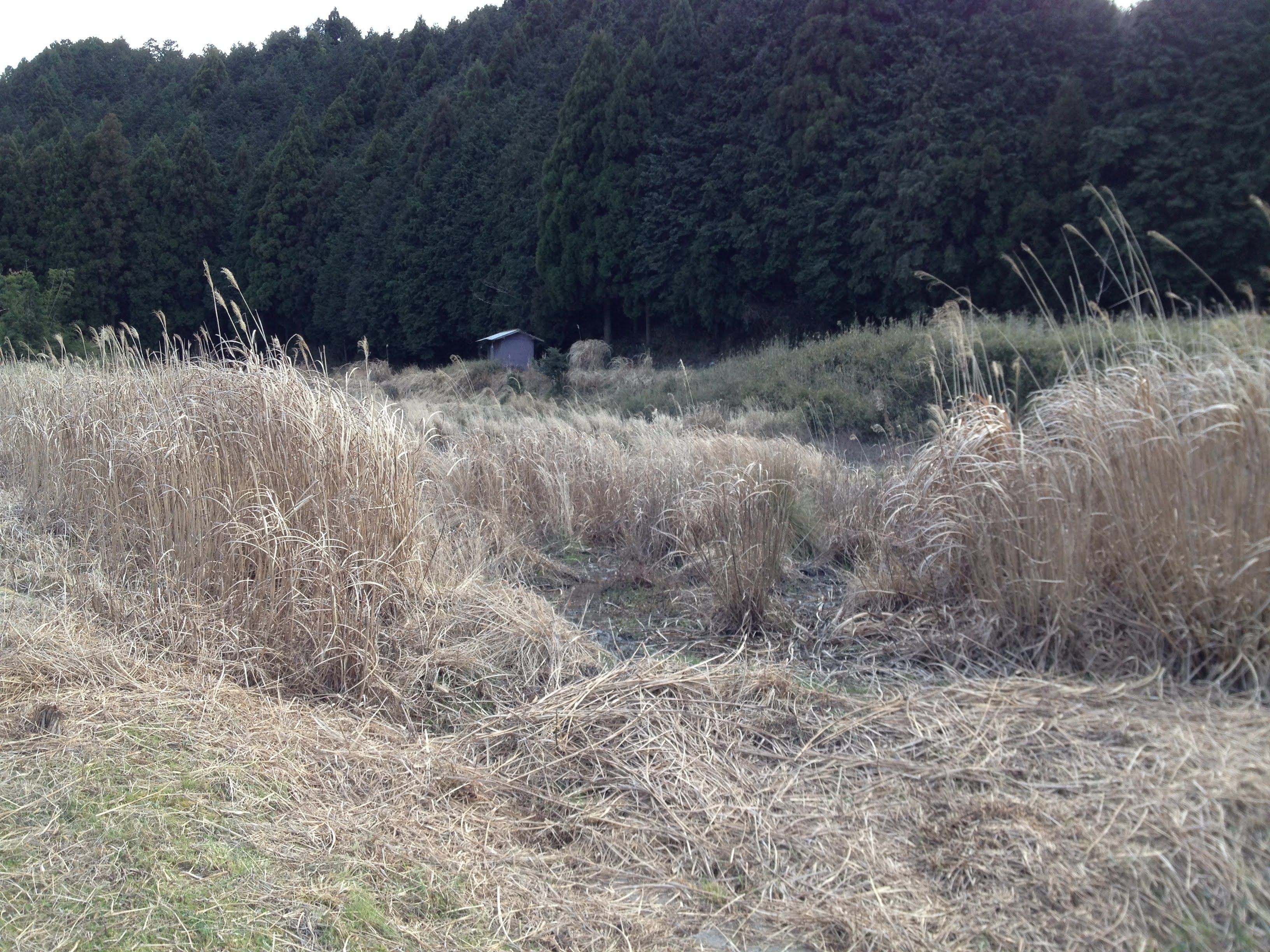
It was a place I'd had my eye on while walking around the neighbourhood.
At the very top of the watercourse, with no fields using pesticides around it.
That was the place I was able to rent.
At the time, the reeds had grown to two metres, the tallest to three.
Animal trails everywhere, deer antlers lying about. The ground was deeply pitted here and there where wild boar had dug it up.
Only the faintest trace of a rice field remained.
But there wasn't a shred of "maybe this is impossible…" in me.
At last I can begin!
There was nothing but that happiness, joy and anticipation.
Everything began with cutting the grass.
One premise. What I write about here is an old-style paddy that has never been through land consolidation.
If you are restoring a consolidated, rectangular field, the situation differs.
Even so, tending to the field according to its situation is, I think, what natural farming is.
Read it across to your own field, think, and put it into practice.
How to do it — timing, tools, sequence
Clearing is done by mid-April, before the rice work begins.
1. Cutting the grass
First cut the grass to grasp the whole picture.
Cut generously, not only the field itself but the area outside it.
That way you can make out the original outline of the field.
You can also find the water channels buried under grass and soil.
Cutting the grass also draws the line between the home of humans and the home of animals.
With no hiding places, wild boar stop coming near.
More troublesome than reeds is the bulrush (hotarui).
Reeds, cut at the base, disappear once the field is flooded,
but the bulrush — perhaps because it likes wet ground — regrows at once if you only cut it.
Remove it by the roots with a spade.
Tools
Two tools for clearing:
・a brush cutter
・a spade
For the brush cutter I recommend
・petrol-driven, 23 cc or more
・not a split-shaft (take-apart) model
Why
Bringing abandoned land back into a rice field takes a fair amount of power.
If the spec says nylon cord can also be used, you can be confident about the horsepower. (Nylon cord isn't suited to clearing, so I don't use it.)
You swing the brush cutter with momentum, so the split-shaft models that are convenient to carry are too weak and don't hold up.
All the more so if you hope to shorten the time clearing takes.
However much you intend to go slowly and steadily, once you start, you end up charging ahead.
In fact, when I was using a split-shaft model that was easy to load into the car, the tubular body snapped.
Also, I don't cut grass with nylon cord.
Because by its nature it sheds bits of cord as waste.
And because I don't cut grass down to bare earth in the first place.
There used to be a product whose torn-off cord decomposed in soil, but it has been discontinued and can't be obtained now.
With the microplastics problem unresolved, I want to avoid as far as possible using things that don't return to nature.
Now that the clearing is done, I use a battery-powered one. (*1)
I plan to switch soon to a split-shaft model. (*2)
The head can be swapped, so I think it will be useful for the upland rice I'll take up in earnest from 2027.
I intend to use it as both a brush cutter and a ground trimmer.
The battery voltage is the widely compatible 18 V, and it serves me well.
Incidentally, electric brush cutters in the 10,000-yen range are no use.
For a spade I use a Kinzo pointed spade. (*3)
2. Removing hazards (while cutting the grass)
While clearing away a rotted fence put up by the previous manager of the field, I stepped on a rusty nail hammered into a piece of wood.
Abandoned land always has man-made objects buried in grass and soil. When you find one, pick it up first. Lose sight of it and it's hard to find again. You don't want tetanus or a festering wound.
All the more so if you bring children.
Even now I always carry a bag for non-burnable rubbish.
3. Animal measures (as soon as the grass is cut)
Growing crops on abandoned land is like farming in the animals' home.
If there are strong signs of animals, don't put it off: build a fence as soon as you can.
Typical fences
・electric fence
・wire mesh
・wooden
・netting
In my case I used netting at first — reused heavy-duty fishing net, so strong that a deer caught in it couldn't tear it.
But it made grass cutting awkward and added work, so I stopped.
After that I switched to an electric fence, which I've used for about ten years now.
An electric fence doesn't block physically; it's a psychological fence that teaches "don't come near" through the pain of touching it.
I worried about the effect of switching from a physical to a psychological fence, but it was no problem.
I use products from the New Zealand company Gallagher. (*4)
Wire mesh costs time and money to install; wooden DIY is unrealistic over such a wide area and its durability is doubtful — so I ruled them out.
Honestly, I don't want to build fences at all. A region where fences aren't needed would be ideal.
I understand the feeling that natural farming should leave things natural,
but after all that effort, it's painful not to be able to harvest.
The separation of people and animals is, I suspect, getting harder in step with rural depopulation.
4. Shaping the field
Picture the ideal scene of ripened ears, and shape the field towards it.
Dream as big as you like.
But rather than building from zero, it's better to imagine the original shape of the field and build on that.
Think it through while looking over the whole from somewhere slightly higher.
Check the flow of water. Where does it come in, where does it go out?
Once you've found the inlet and outlet, rebuild the frame — the ridges — so that water will pool.
At first it's hard to dig a straight line of 10 or 20 metres with a spade,
so stretching a rope or string as a guide makes it easier.
Push the pointed spade in along the rope, then push it in parallel one spade-width away. Push the spade in at the left and right ends towards the cuts, and a clod comes out whole.
Repeat this to dig onwards.
Use the clods to repair ridges and fill holes.
5. Repairing the ridges
Land abandoned for years has many animal trails, and the ridges and stone walls have collapsed.
Repair collapsed ridges by putting back the scattered stones and heaping up soil.
After that, it's good to plaster with mud, as in ridge plastering.
With mud, the amount of water is hard to judge. It easily turns to slop, or has too little water and won't knead. This you can only learn by repetition.
Failures during clearing, and what I did
Failure: I expanded too much in the first year.
I was told "you can use the upper terraces too", and gratefully rented the whole block. The result was an area beyond my means in the very first year, and days of racing to simply get it finished rather than doing it with care.
My diary of the time reads:
A fool who doesn't know his limits,
preaching natural farming,
is making light of life.
I came to know in my body that, without noticing, I had drifted away from my own feet.
(Blog "Mother is the Earth, Father is the Sky", "Day Forty", 3 June 2015)
From that year's reflection I decided: "One non-glutinous rice, one glutinous rice. First, grow these properly. A year's harvest is a result, not the goal."
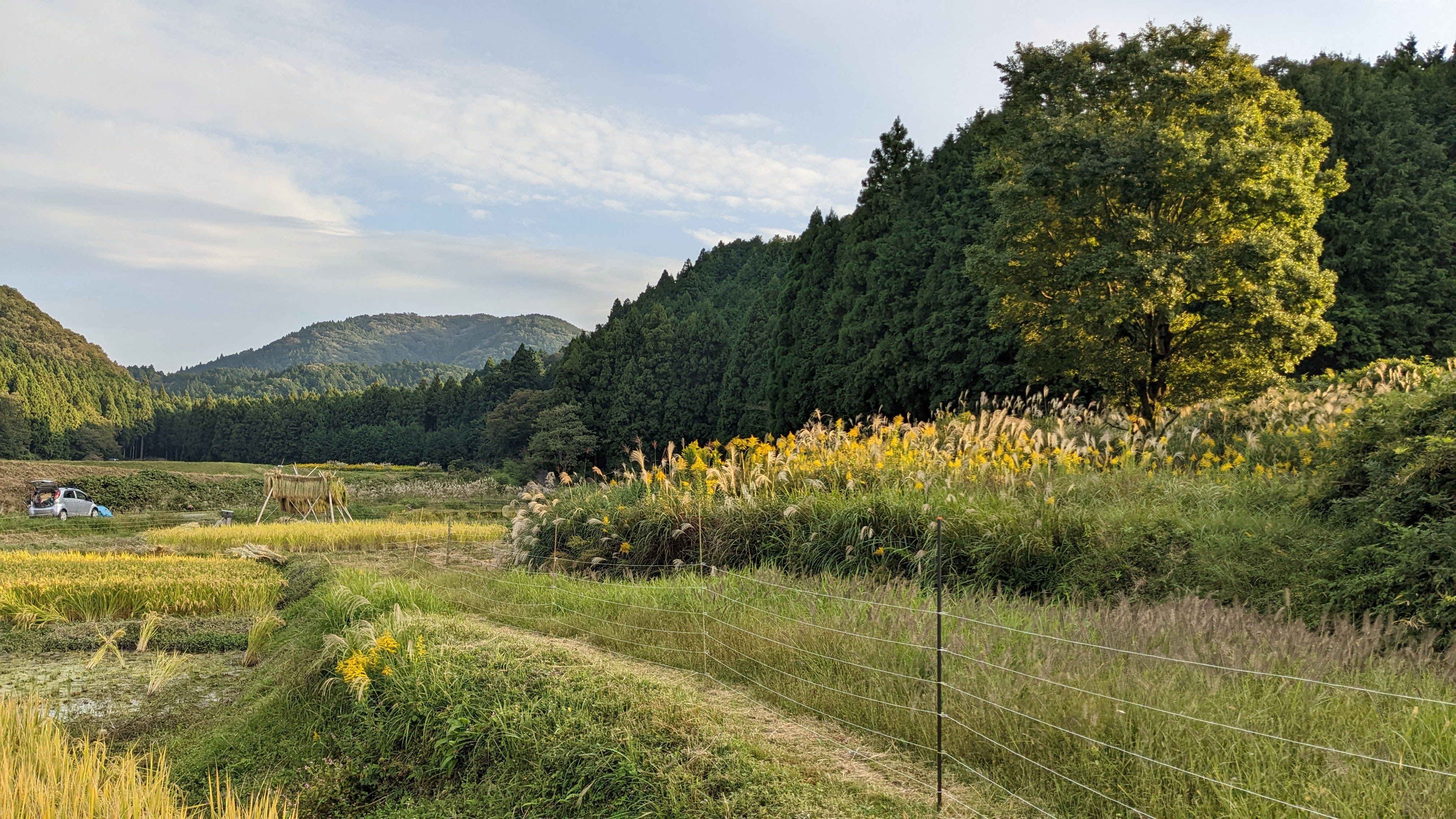
End-of-chapter column: the word "abandoned"
While cutting grass and working, all sorts of things come to mind.
People say "abandoned land", but
there are birds' nests everywhere.
They're easy to see, so you notice.
It hadn't stopped; the activity of life went on.
It's merely a place where humans gave up cultivating;
the place was never in suspended animation — it continued.
(Blog "Landing on the Soil", "Two: Clearing", 22 March 2016)
That's what I wrote in my work diary ten years ago.
Human activity may have stopped, but the activity of life — grass, insects, fungi, small animals and so on — has continued all along. I don't want to forget the feeling that I am intruding on that activity.
Also, making a rice field is not a job that ends in a year.
It's the accumulation of year upon year.
Don't rush; enjoy it.
Next time: "Water — the warp and weft of relationships". The story of a water channel I thought was dead, and wasn't.
Tool list
1 Brush cutter Makita cordless brush cutter, 18 V (PR)
2 Split-shaft brush cutter Makita split-shaft cordless brush cutter, 18 V (PR)
3 Pointed spade Kinzo pointed spade (PR)
4 Electric fence energiser Gallagher MBS100x (PR)
The table of contents for the Kindle edition is here ↓
Contents map on note (in Japanese)
📚 See also
🌱 Digital DIY course materials (in Japanese)
・[Free] Site Controller Build Guide
→ https://brain-market.com/u/kinako666/a/b4cDO1UjMgoTZsNWa0JXY
・AI posts for you every day | DIY automated SNS posting in 7 days for 0 yen a month
→ https://brain-market.com/u/kinako666/a/b1MTN3UjMgoTZsNWa0JXY
✉️ Newsletter "Kakuuchi" (entirely handwritten)
Behind-the-scenes stories of daily life, from weeding to using AI.
→ https://flow-yamagen.com/en/mail-magazine/