This year, too, thanks to you all, the rice-growing workshop farm flow has begun.
Three newcomers, with their enthusiasm and excitement — "I can finally grow rice!" — reminded me of my own beginnings.
Thank you.
When I was just starting, I devoured and tried out not only the books of the natural-farming lineage — Masanobu Fukuoka, Yoshikazu Kawaguchi, Nobuo Iwasawa, Kenji Honda — but also information on conventional farming.
Rather than natural farming VS conventional farming, the co-op's information on conventional methods is, in its own way, human wisdom worth learning from.
Even so, I have never once wanted to use herbicides or pesticides.
My own natural farming is about balancing the farm work that suits that particular field with the other parts of life.
Creation rather than negation.
I renewed my resolve to do cheerful fieldwork, each helping the other.
Here's to the year ahead!
This time we did:
・making rice-husk charcoal
・preparing the seedbed
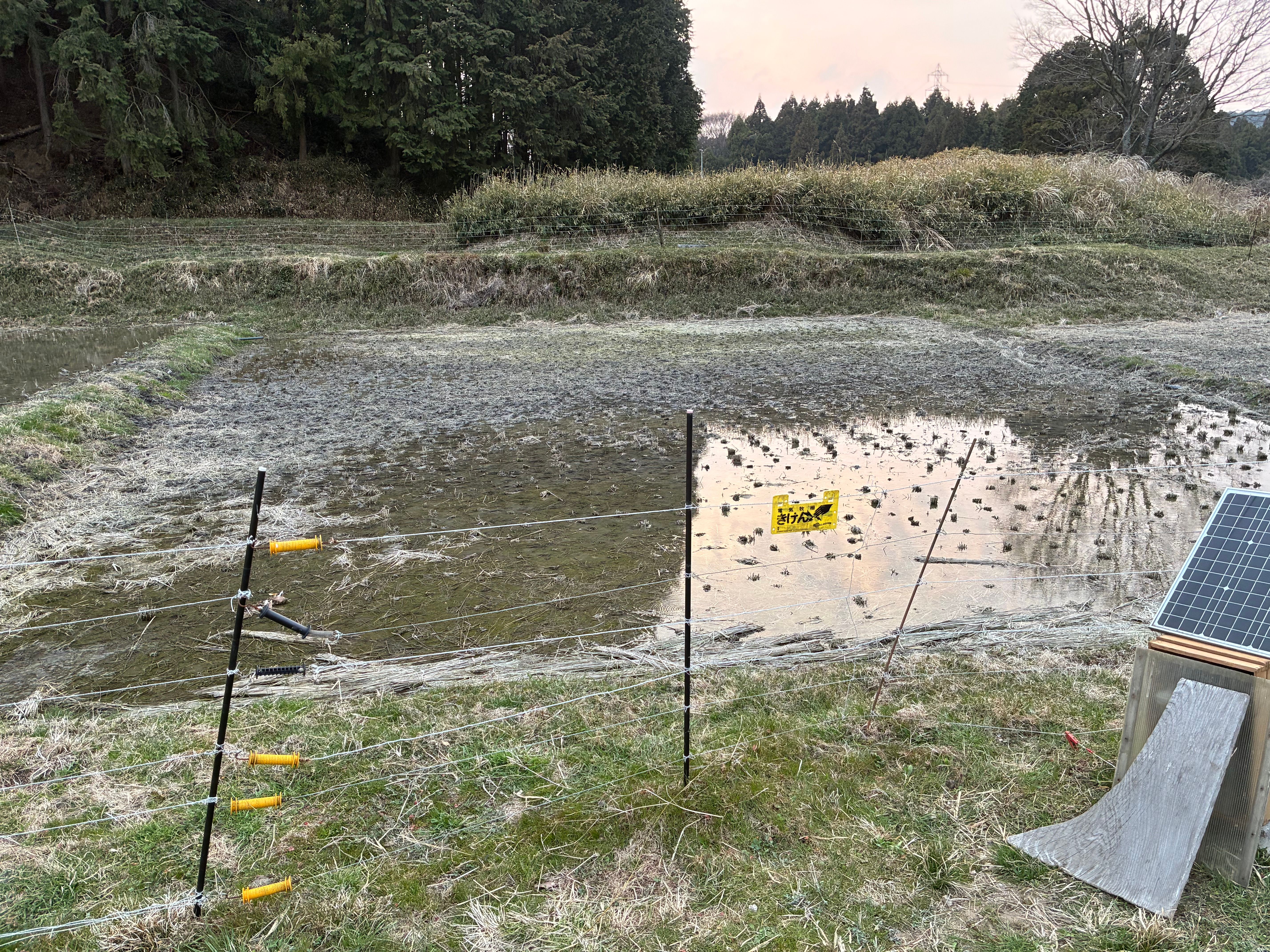
・setting up the electric fence
・checking the water channel
Some thoughts on each.
・Rice-husk charcoal
It didn't go well with the half-broken charcoal burner.
Broken tools really do just cost effort, so tools need inspecting and checking before the work!
We managed with a borrowed burner. Thank you.
・Seedbed preparation
A new member with over ten years of natural-farming vegetable growing showed us how she makes beds.
Levelling by hand — good for people whose hands don't get chapped by soil, I thought.
I learned a great deal, watching as if learning from scratch.
We weeded together and finished preparing for sowing.
・Electric fence
With one person per post, we finished in a single lap.
There are six posts in all, so until now I'd been doing six laps — I felt the possibility of working together.
・Water channel
From next year I'm thinking of daily water management: once the snow melts, dam the channel in the evening and open it in the morning. That should keep the field flooded through winter.
For the coming season, I'll dam it before work and open it after.
If water goes downstream during the day, we shouldn't cause anyone trouble.
Every year I try something new.
This year, two things:
・direct sowing → think of it as a giant seedbed
・copying the SRI method a little more faithfully → until now it's been SRI-ish
Answering again the questions asked on the day:
・What varieties?
Six: Shiga Asahi, Kamenoo, Mangetsu-mochi, Midori-mochi, Happy Hill and Asamurasaki.
・Why no machines?
It's about looking again at where I stand. It's easy to criticise modern society or to find the causes in others — but what about me? What do I want to hold dear in living my life? The answer I found for myself in my twenties was welfare and farming. Mechanisation makes mass production and efficiency possible, but I felt that the richness I have in mind lies precisely in what was lost through it.
At first I didn't even use a mower, but once children started coming to play, I wanted a place where snakes and ticks find it hard to live. As the area grew and I began mowing to remove hiding places, I no longer felt like cutting everything by hand at the expense of everything else.
・Where does the seed rice come from?
Shiga Asahi — a friend
Happy Hill — an acquaintance
Midori-mochi — Nouken (Yamashina)
Mangetsu-mochi — Natural Farm cocoro in Gujo
Kamenoo — unknown (a seed exchange in Kyoto)
Asamurasaki — unknown (a seed exchange, or Nouken)
・Seedbed size
"1 tan, 2 mats, 3 gō"
Seedlings for 1 tan (about 1,000 m²) are raised on a seedbed the size of two tatami mats, sown with 3 gō (about 450 g) of seed.
Planting spacing is 45 cm × 45 cm, one seedling per spot.
・Selecting seed
Fill a bucket with water.
Put the seed rice in.
Use the ones that sink.
I tried salt-water selection for some years, but since at harvest I cut the most vigorous rice for seed, for now I don't think salt water is needed.
・Soaking seed
About a week at a water temperature of around 12°C.
Change the water every day.
When they swell to "pigeon-breast", they're ready.
・Sowing date
This year I'd like to make it by Saturday 11 April.
Some things we want to do, we can't.
Failure is the real learning.
Let's enjoy the year, each helping the other!
(Hideo)