
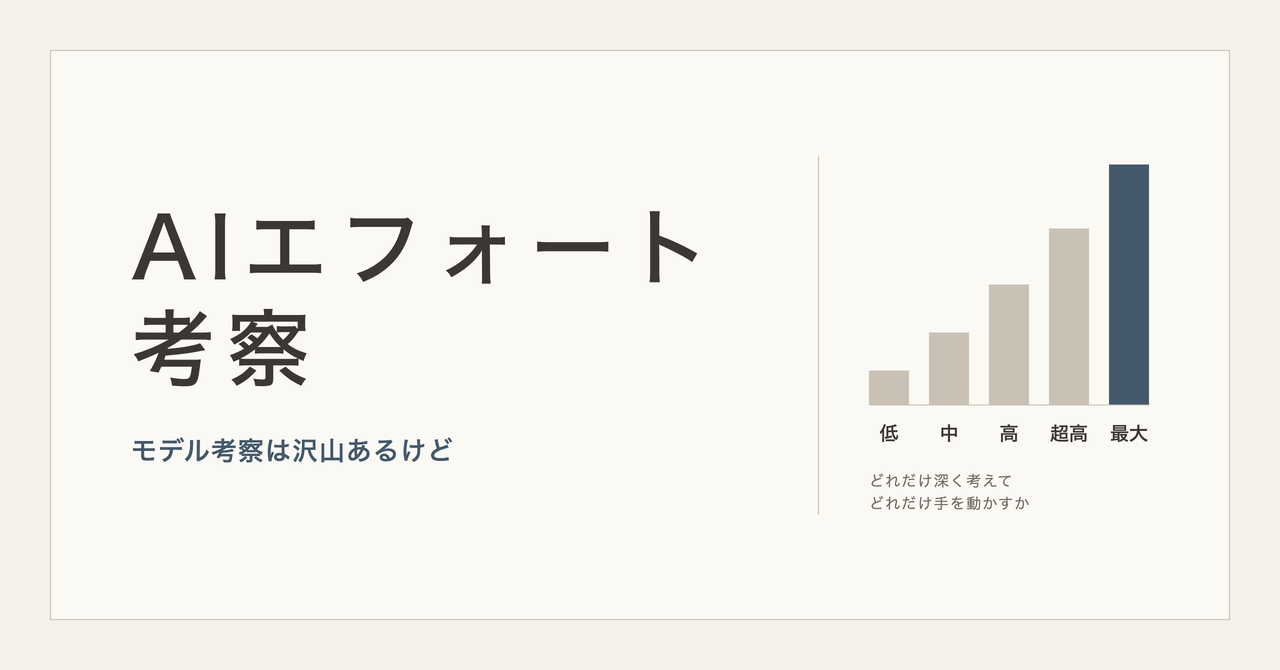
There isn't much written about "effort". Plenty about models, though.
— Hideo
This article arranges, as questions and answers, an exchange between Hideo (flow, Maibara) and an AI (Anthropic's Claude) on the morning of 27 September 2026.
The questions are in Hideo's own words; the answers are the AI's explanations, tidied for reading.
Introduction: the "effort" setting
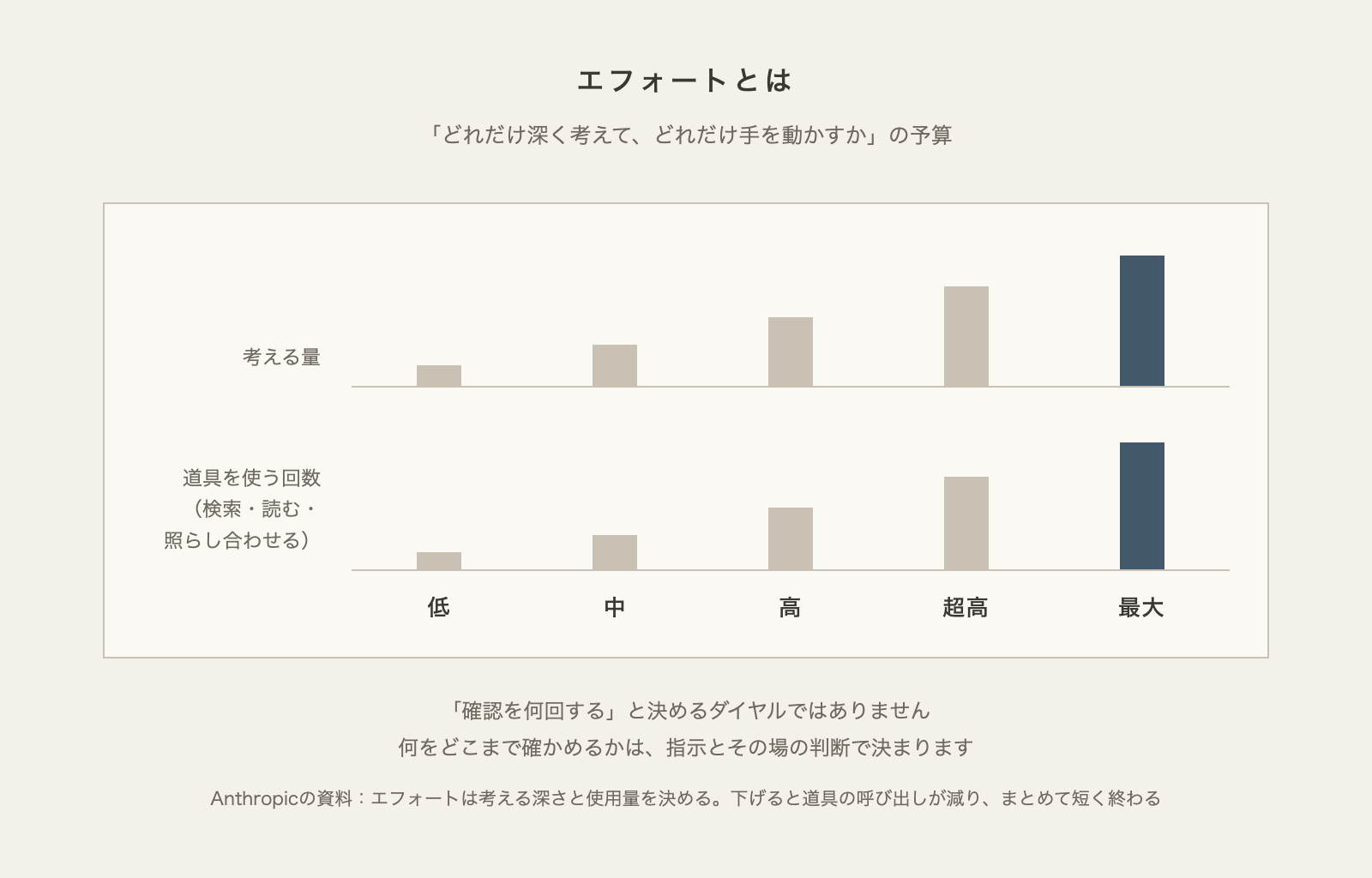
Claude has a setting called "effort". It has five levels — low, medium, high, extra high and max — and decides how much energy the AI puts into a single task.
In Claude Code (the desktop app) that Hideo uses, you choose it from the toolbar.
Over the past few days, Hideo had been trying similar jobs while changing the model and the effort.
These past few days I've been trying Opus 5.5 at extra high, but today I went back to Fable 5.1 at high for the first time in a while. (26 Sep)
Trying Opus 5.5 again today. I chose max effort. (27 Sep)
Here are the questions that came up that morning, in order.
Question 1: Does raising the effort raise accuracy?
Hideo
When I raise the effort, does the AI check things more often? Does it gather more evidence? Instead of a quick look and done, does it dig all the way down?
AI
It does check more. But accuracy doesn't rise in step with it. Effort is something like a budget for "how deeply to think and how much to do by hand" (not a strict ceiling, though — more a signal to the AI of how hard to try).
Anthropic's documentation explains that effort sets the depth of thinking and the amount of usage; lowering it reduces how often tools are used (searching, reading files, cross-checking) and makes the AI wrap up shorter.
When accuracy matters more than cost, max is the right choice; for everyday conversation and routine tasks, raising it makes little difference.
It is not, however, a dial that sets "check this many times".
What gets checked, and how far, is decided by the instructions and by judgement in the moment.
The day before, the AI had reviewed course materials by reading an old copy of a file, and the work had to be done twice.
That is the kind of problem raising the effort doesn't fix. What fixed it was the instruction: "read the real thing".
Question 2: Are low and medium for people who want to save?
Hideo
So medium and low effort are only for when you really want to economise — for simple chat?
People who use AI like a friend, or people doing very heavy work?
Is making video or games heavy on usage?
For text chat, is a small amount enough?
Is it proportional to mobile data usage, I wonder?
AI
That understanding is roughly right. Three things to add.
- For simple questions, chit-chat and routine tasks, raising the effort barely changes the quality of the answer; it only adds time and usage. If you use AI as someone to talk to, low or medium is often enough.
- What increases usage is not the kind of work, but how much the AI reads and writes. Jobs like building a game, where large amounts of code are written and corrected, get heavy. Claude doesn't make video itself, but if you have it read many images, usage goes up accordingly. Even in the same chat, as the conversation gets longer the AI re-reads the whole history every time, so it gradually gets heavier.
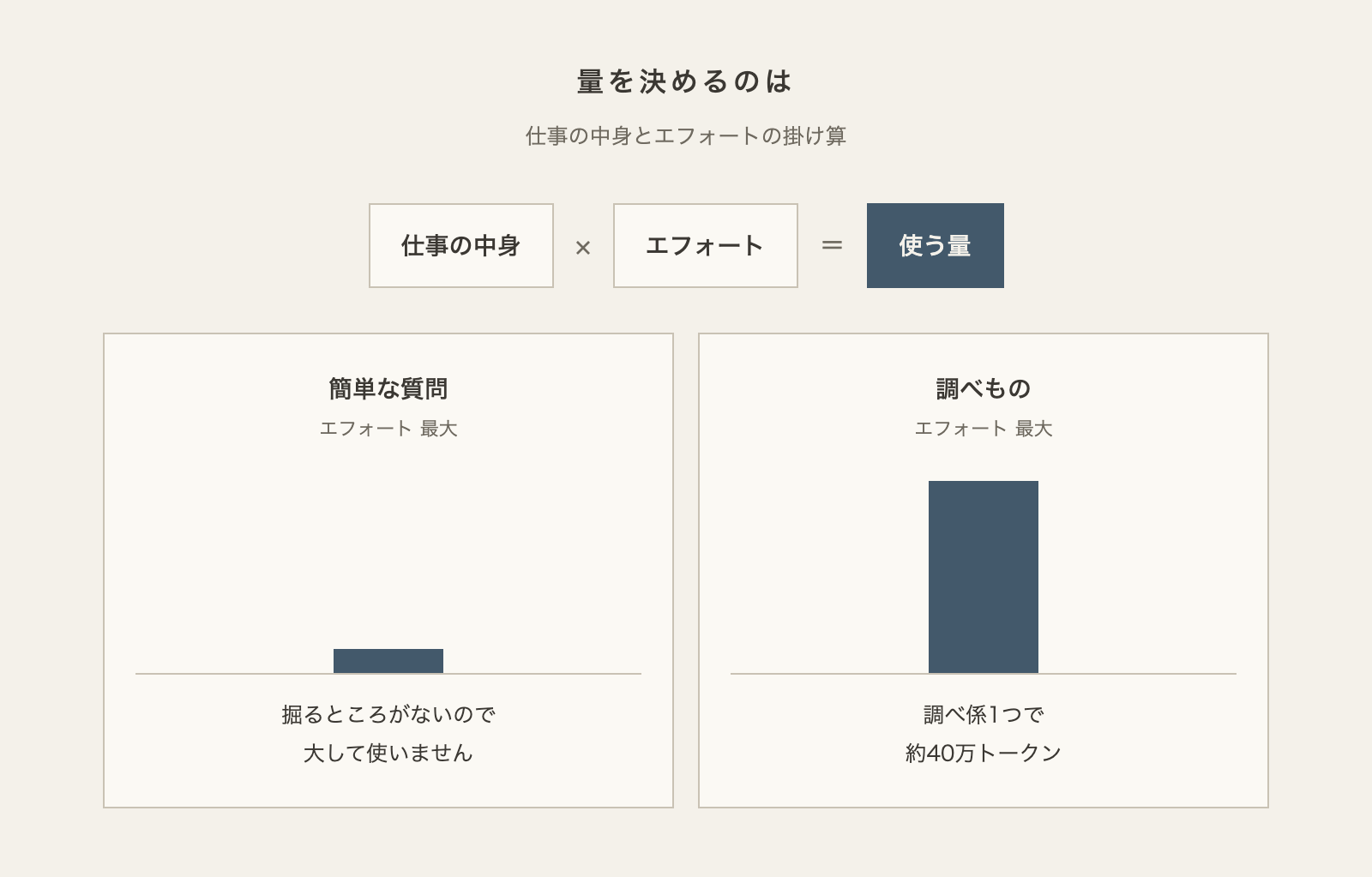
- It resembles mobile data in that "what you use eats into your allowance" (tokens are the gigabytes). The difference is that effort is closer to "a setting that raises the ceiling on how much may be used". Even at max, a simple question has nothing to dig into, so it doesn't use much.
What decides the amount is the content of the job multiplied by the effort.
That morning's research (fact-checking a book, and finding a sports class the family could attend) was split by the AI into two tasks handed to separate AIs (research assistants), each using roughly 400,000–450,000 tokens.
Question 3: Work that looks hard, and work with many steps
After each task, I had the AI say in one line which effort level would have suited it (how that came about is in Question 5). For that morning's three tasks, it said:
- Registering SNS posts: low would have been enough (a fixed routine — tidy up and register)
- Tool maintenance: high was enough (the places to fix were clear, and tests could confirm the result)
- Research: max was right (there were many moments of re-reading the official source)
Hideo
Effort. So research involves a surprising amount of back-and-forth. It happens when images have to be checked.
I had the impression tool maintenance would be the harder one.
AI
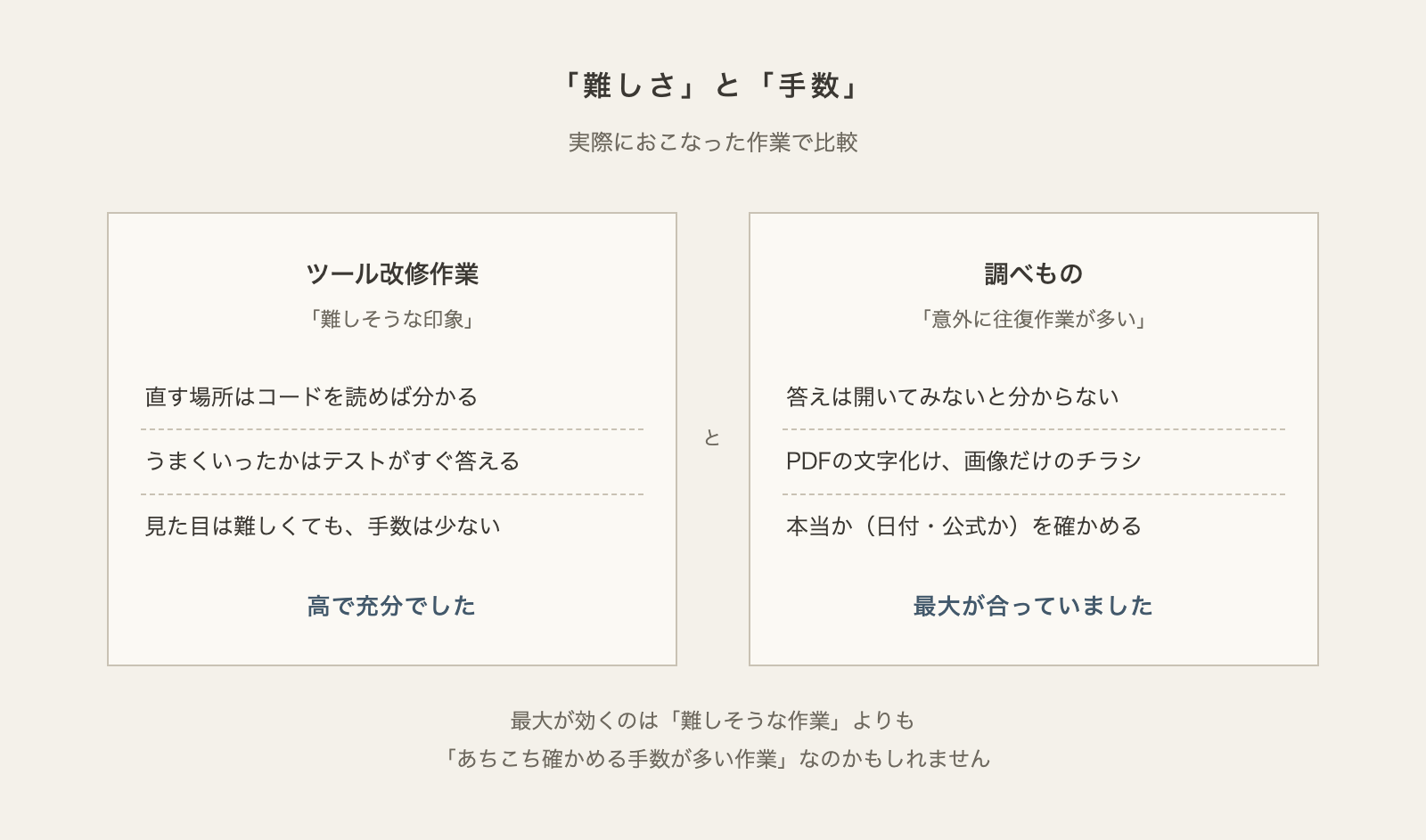
I think it's the difference between "difficulty" and "number of steps".
- Tool maintenance looks hard, but the path was clear. Reading the code tells you where to fix, and 622 tests answer right away whether it worked. It may look difficult, but it takes few steps.
- Research is easy step by step, but you can't see ahead.
You don't know which page holds the answer until you open it.
And when you open it, the PDF often has no text layer, or the text is garbled, or the flyer is just an image. Each time, it has to be turned into an image and read again, so the back-and-forth grows. Confirming that what you found is true (is the date recent? is it official?) takes another round trip. That morning's two research assistants used tools 125 times (27 minutes) and 258 times (36 minutes) respectively.
Perhaps max helps less with "work that looks hard" than with "work that has many steps of checking here and there".
Question 4: High for everyday, max for reviews — is that fine?
AI (from the answer to Question 2)
Even at max, a simple question has nothing to dig into, so it doesn't use much.
Hideo
In that case, my current way seems fine: high for everyday use, and max for jobs like reviewing the Brain course materials.
AI
Yes, that's right.
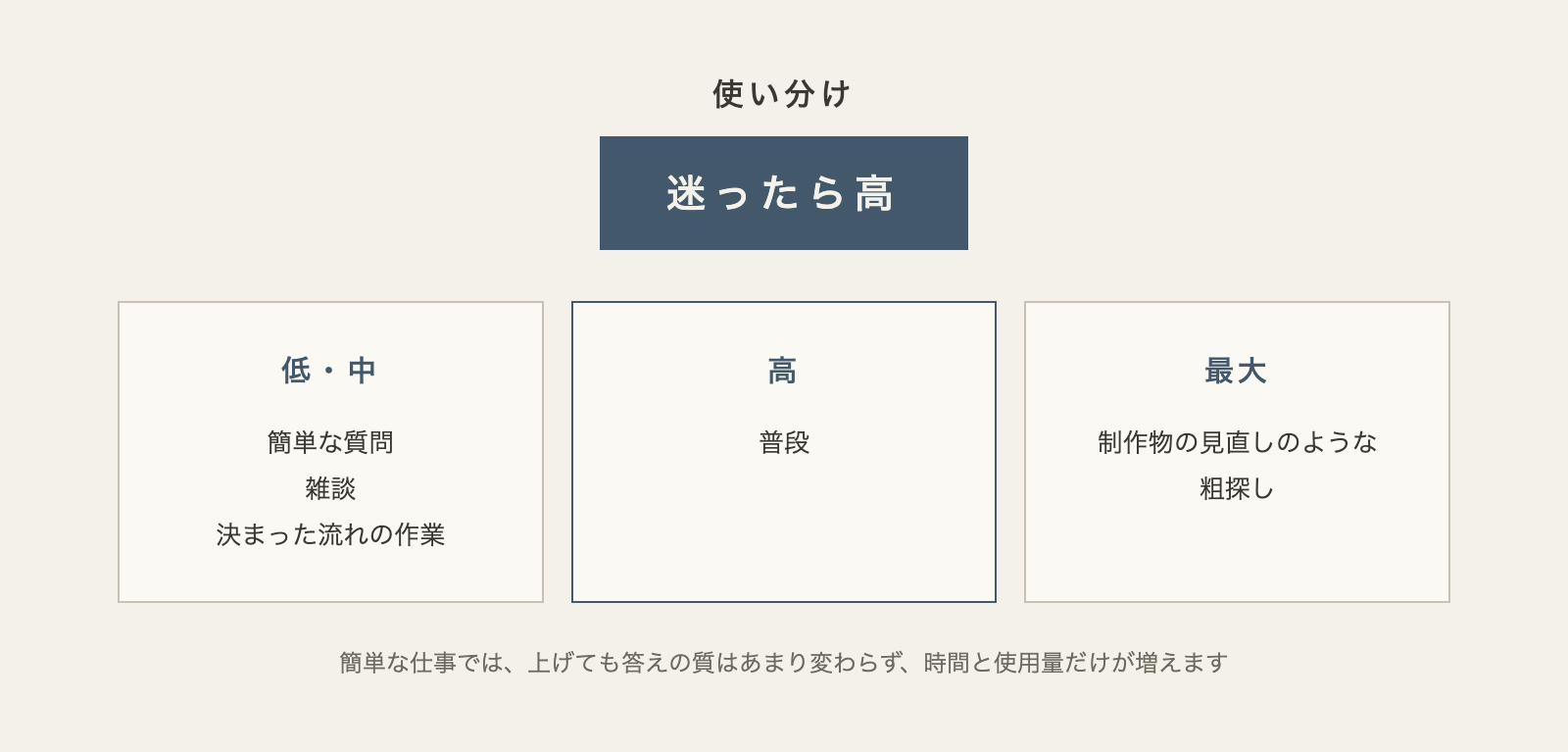
- Low / medium: simple questions, chit-chat, routine tasks
- High: everyday use
- Max: fault-finding such as reviewing a finished product (reading the real thing and cross-checking here and there)
When in doubt, high. Too low and quality drops in the form of things missed; too high and it only adds time and usage.
Question 5: Can you tell me in advance that "low is enough for this"?
Hideo
For example, could you judge "low is enough for that instruction" and suggest it to me?
Or I wonder whether judging the right effort in advance is impossible in principle.
AI
To some extent, yes. Reading the request gives a rough idea. But there are three limits in principle.
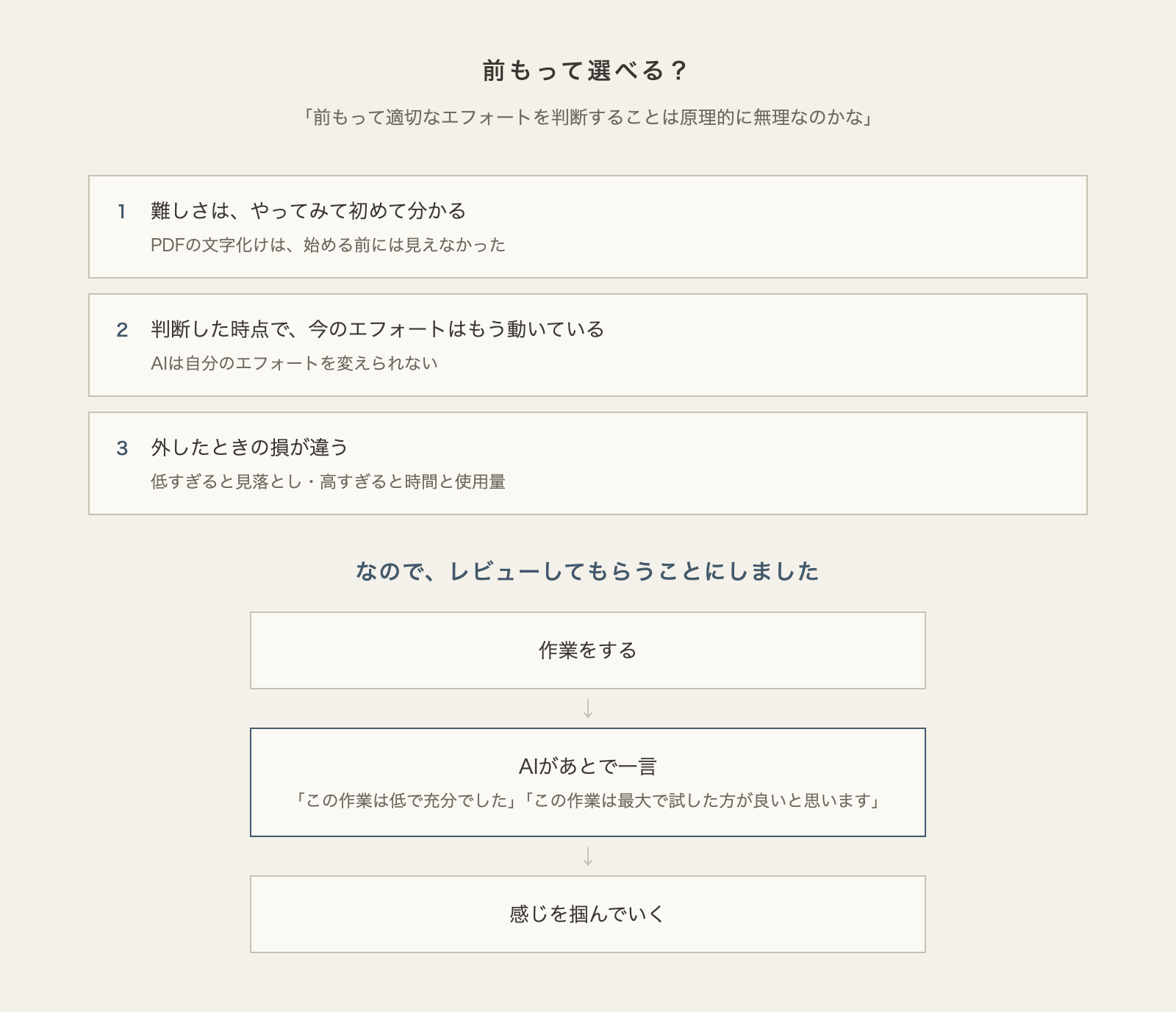
- Some difficulty only shows itself once you start. That morning, too, the local newsletter PDF was garbled and had to be turned into an image and read again. That wasn't visible before starting.
- By the time it judges, the current effort is already running. The AI can't change its own effort, so the advice only takes effect from the next request.
- The cost of getting it wrong differs. Too low means things missed; too high means time and usage.
So the AI proposed: "only when it's clearly mismatched, add a word before the work".
Hideo
Thanks for the effort suggestion. I'd like to try the reverse: "low was enough for this task", "I think this task is worth trying at max" — I want to get a feel for it that way.
So we settled on having the AI review it afterwards.
Closing
Hideo
The way we phrase requests — prompts — has changed as AI has evolved, but even with effort at max, I felt the importance of the instruction is just the same as before.
This article was arranged by AI into questions and answers from a conversation log with Claude (Opus 5.5, max effort). The diagrams were also made by AI; Hideo edited the words.
📚 See also
🌱 Digital DIY course materials (Brain, in Japanese)
・Site Controller Build Guide | build your own vacancy sync that runs for 0 yen a month
→ https://brain-market.com/u/kinako666/a/b4cDO1UjMgoTZsNWa0JXY
・While I was in the rice field, one of my courses sold | DIY automated SNS posting in 7 days for 0 yen a month
→ https://brain-market.com/u/kinako666/a/b1MTN3UjMgoTZsNWa0JXY
・Bring out your AI's best | that prompt may be holding a smarter AI back
→ https://brain-market.com/u/kinako666/a/bzUDMzYjMgoTZsNWa0JXY
・How to build an AI editorial desk | you write, AI tidies
→ https://brain-market.com/u/kinako666/a/b3UDMyYjMgoTZsNWa0JXY
✉️ Newsletter
From weeding to using AI — behind-the-scenes stories of daily life. A letter that leaves you a little more forward-looking: that's what we aim for.
→ https://flow-yamagen.com/en/mail-magazine/
🏡 flow website
→ https://flow-yamagen.com/en/
🎨 Yu's works | Saatchi Art
→ https://www.saatchiart.com/en-jp/account/profile/3071009
📱 Social
・Instagram → https://www.instagram.com/flow_yamagen/
・note → https://note.com/flow_move
・Substack → https://substack.com/@flowhideo
・Threads → https://www.threads.com/@flow_yamagen
・Facebook → https://www.facebook.com/flow.maibara
・YouTube → https://www.youtube.com/@flow_-cr9nx